

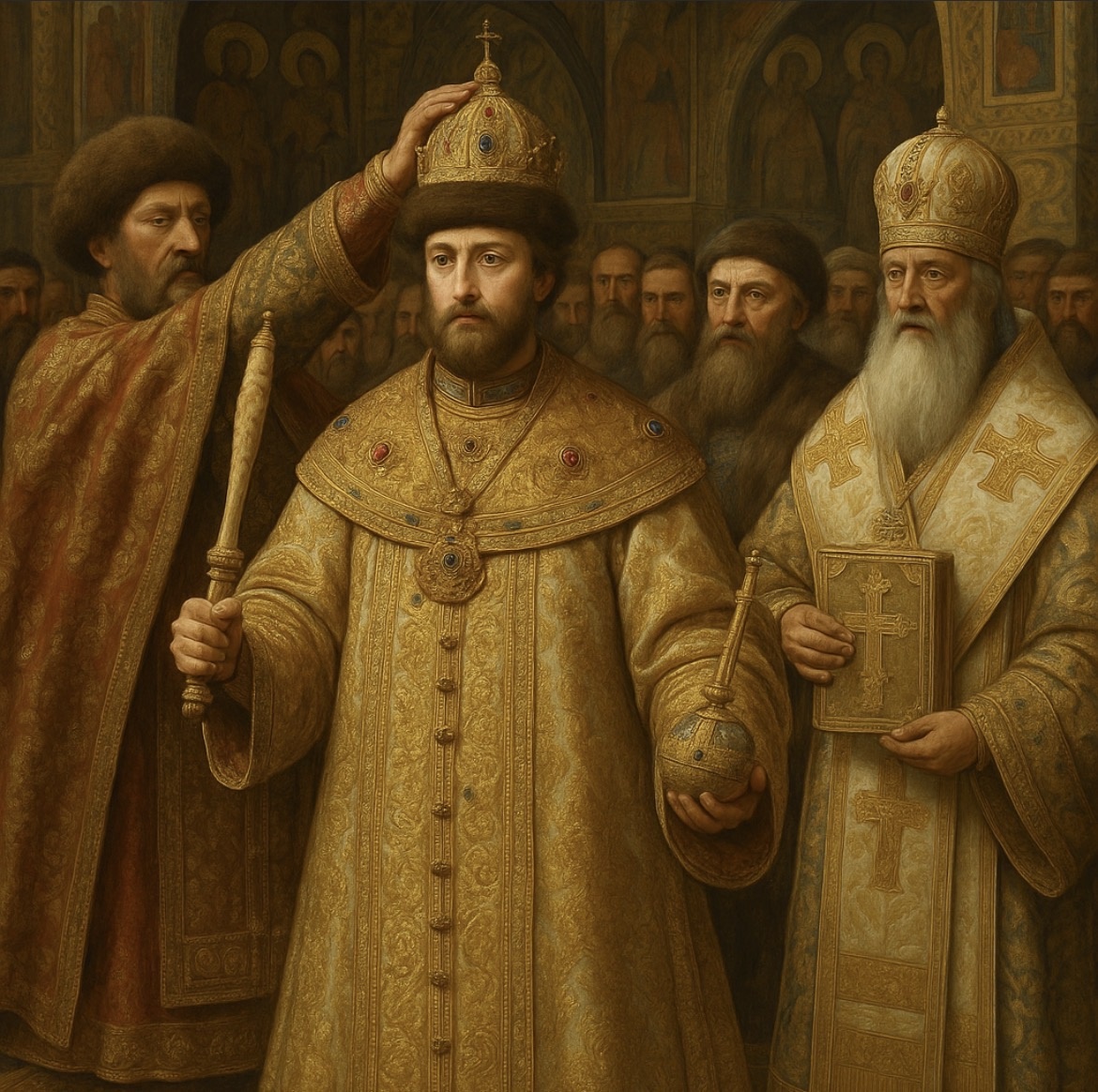
In the memory of posterity, Tsar Feodor Ivanovich, son of Ivan the Terrible, remains an almost comical figure—a gentle, pious, "simple-minded" monarch whose reign was merely a prologue to the rise of Boris Godunov. This image of a benevolent ruler incapable of power, who preferred the ringing of bells to matters of state, is firmly ingrained in history. However, the actual circumstances of his rise to power shatter this stereotype. They are full of drama, fierce political intrigue, and surprising paradoxes. The first days of the reign of the last Rurikovich on the Moscow throne were not a quiet transfer of power, but a veritable political thriller. Let's uncover some of the most unexpected facts hidden behind the façade of official history.
1. "Child of the Great War": The Tsar Whose Childhood Was Spent to the Roar of Cannons
The year of Feodor's birth, 1557, was perhaps the "last year of tranquility" for the Muscovite state. The country stood at the height of its power, enjoying the fruits of recent victories. The Kazan and Astrakhan Khanates had fallen, and the threat from the east had been eliminated. The state was rapidly transforming: a new Code of Laws was issued, a formidable Streltsy corps was created, the artillery depot grew, and the Church, at the Stoglav Council, brought order to its affairs. It seemed the Tsarevich was destined for a life in a prosperous and peaceful realm.
But in 1558, when Feodor was not yet a year old, the grueling 25-year Livonian War began. This bloody conflict became the backdrop for his entire childhood, adolescence, and youth. Herein lies the first paradox: the Tsar, renowned for his meekness and non-belligerent nature, was in fact a "child of the great war." He grew up surrounded by talk of battles, witnessed regiments marching westward, and heard the commanders' reports of victories and defeats. The source paints a poignant picture of his childhood: at five years old, clutching his older brother's hand, he watches his father riding on horseback at the head of a brilliant retinue to defeat Lithuania. Will he return? And the boy's lips, of their own accord, begin to whisper a prayer.
The Livonian War became the cradle from which he grew; the commanders' reports rivaled bedtime stories...
Perhaps it was this harsh upbringing, steeped in the violence and hardships of war, that shaped his character. It's possible that his renowned religiosity and peacefulness were not an innate weakness, but a conscious reaction to the cruelty of the world in which he grew up.
2. The "Spare" Heir: The Crown He Was Never Prepared for
Feodor Ivanovich was never intended to become tsar. He always lived in the shadow of his older brother, Tsarevich Ivan, whom Ivan the Terrible envisioned as his successor and actively groomed for the governance of the state. All of his father's attention and political education went to the eldest son.
. This does not mean that Fedor was kept locked up. His father tried to accustom him to state affairs: the prince participated in religious processions from an early age, attended the appointment of metropolitans with his father, went with his father to watch the City Building in Vologda. But this science did not go for the future. Both the father, and the yard, and Fyodor himself understood that he was a “reserve” option, and they did not seriously prepare him for power. The prince did not show interest in politics, preferring the "beauty of worship." The episode with his marriage is indicative: Ivan the Terrible, like a Shrewd politician, married his son to Irina Godunova to tie a faithful, but not too noble clan to the heir. Fyodor, ignoring all the intrigue, simply "seriously became attached to his wife." The drama of the situation manifested itself in 1581, when Tsarevich Ivan suddenly died. Fedor suddenly became the only heir to a huge power. But the aging Ivan the Terrible no longer had time to prepare him for this role. And God gave the royal crown to the one who was not prepared for this burden. It was this unpreparedness of the new king that created ideal conditions for the vacuum of power. Immediately after the death of Grozny, a fierce struggle began for the boyar clans - Mstislav, Shuisky, Yuryev - each of which sought to rule the country on behalf of the monarch, inexperienced in politics.
3. Invisible monarch: how the king "disappeared" during the first state crisis, the death of Ivan IV on March 18, 1584 immediately plunged the court into chaos. Between the most noble nobles, a “great confusion” began - a struggle for influence under the new sovereign. This conflict quickly poured out onto the streets of Moscow. In early April, an uprising broke out in the capital, which, according to historians, was staged by aristocratic groups (Shui and Mstislavsky) to eliminate their main enemy, the favorite of the late Tsar Bogdan Velsky. The incident resembled a scene from a political thriller. Armed nobles and townspeople gathered near the walls of the Kremlin, who "feeled" the strength of the gate with a ram and unfolded the cannons against the fortress. The Kremlin was under siege. The archers fired from the serrated walls, in response, a hail of bullets and arrows flew, and the affected warriors fell into the ditch. And in the center of this first state crisis, one fact is striking: the role of Fyodor Ioannovich himself is “not visible”. It's like he doesn't exist. He seems to be missing. All decisions - negotiations with the rebels, Velsky's exile, the removal of Tsarevich Dmitry from the capital with his family - are made behind his back by powerful nobles.
The new tsar's powerlessness was most vividly described by the ambassador of the Polish-Lithuanian Commonwealth, Sapieha: "...and the sovereign is not one who could prevent this."
The monarch's position was precarious beyond belief. Formally, he wielded absolute power, inherited from his father, but in reality, he was merely a passive observer in someone else's political game unfolding at the gates of his own palace.
4. The Coronation Spectacle: Who Really Held the Symbols of Power
The coronation ceremony on May 31, 1584, was staged with incredible pomp. Englishman Jerome Horsey, an eyewitness, described the royal robe weighing 200 pounds (over 90 kg), the unicorn bone scepter, and the gold brocade laid at the monarch's feet. However, behind this glittering façade lurked a subtle political intrigue, and Russian chronicles reveal its essence.
The distribution of roles at the ceremony was not simply a tribute to tradition, but a public demonstration of the true balance of power at court. The most important moment of the liturgy—when the Tsar temporarily removed his regalia—revealed who truly wielded power. The main symbols of the monarchy were distributed as follows:
The Tsar's Crown: held by Prince Ivan Mstislavsky, a descendant of the Lithuanian princes Gediminids and the most distinguished nobleman of the state.
The Scepter: held by Prince Vasily Skopin-Shuisky. His family, the Shuiskys, was a branch of the Rurik dynasty itself and were considered "princes of the blood," with potential claims to the throne.
The "Apple" (orb): went to Boris Godunov.
This fact irrefutably proves that at that time, Godunov was not yet an all-powerful ruler. In the unofficial hierarchy, he occupied only third place, after the heads of the ancient aristocratic clans. But what was most striking was something else. The only person to whom Feodor himself bestowed this unusually high honor was not a nobleman, but his confessor, Archpriest Eleutherius. It was he, a simple priest, who led the entire procession, ahead of the metropolitan and archbishops, and carried on his head the main regalia—the "life-giving cross," the "royal crown," and the "diadima." This incredible gesture speaks eloquently of the tsar's true priorities, which lay in the spiritual, not the political, realm.
Conclusion: The Beginning of a New Era
The first days of Feodor Ivanovich's reign are full of paradoxes: a peacemaker tsar, raised in war; an unprepared ruler who inherited absolute, unfettered power; a monarch whose coronation became an arena for the struggle of his own nobles. These events demonstrate that the accession of the last Rurikovich was not the beginning of a peaceful era, but the start of a new, unpredictable political game.
So who was the last Rurikovich on the Russian throne—just a passive figure on the chessboard of history, or a ruler whose true role we have yet to understand?
Here we have what appears to be a Native American playing the pan flute on Batumi’ Boulevard that runs along the sea.
All the while the sun is falling in the West and now sinking into the Black Sea.
A big shout out to the people who follow me. Unfortunately I’ve had to leave Russia. It became impossible to receive any funds from the US. I am currently living in Batumi, Georgia.
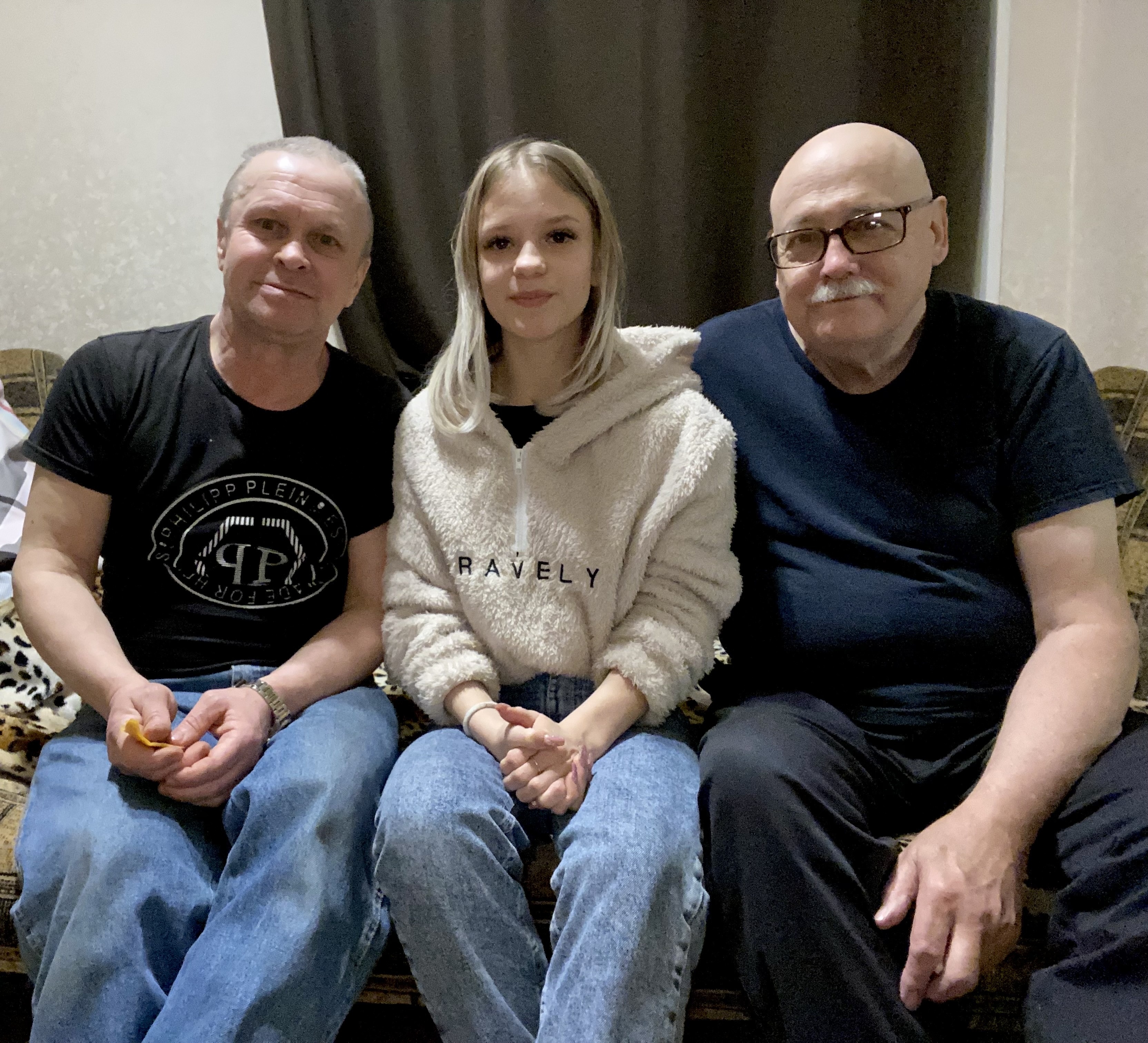
This is my family in the living room of my apartment in Kimovsk, Russia. I am a disabled Vietnam veteran. Seventy eight years of age. My son Aleksandr (left), and my granddaughter Dasha (center) look in on me. Here, I had hoped to live out my retirement years.
#UkraineRussiaWar #MilitarySummary
🏴 KOSTIANTYNIVKA CAPTURED — After 186 days of brutal fighting, Russian forces raise flags across the city. Geolocated footage confirms control of the Chervony micro-district. Ukrainian officials deny full capture, but the maps tell a different story.
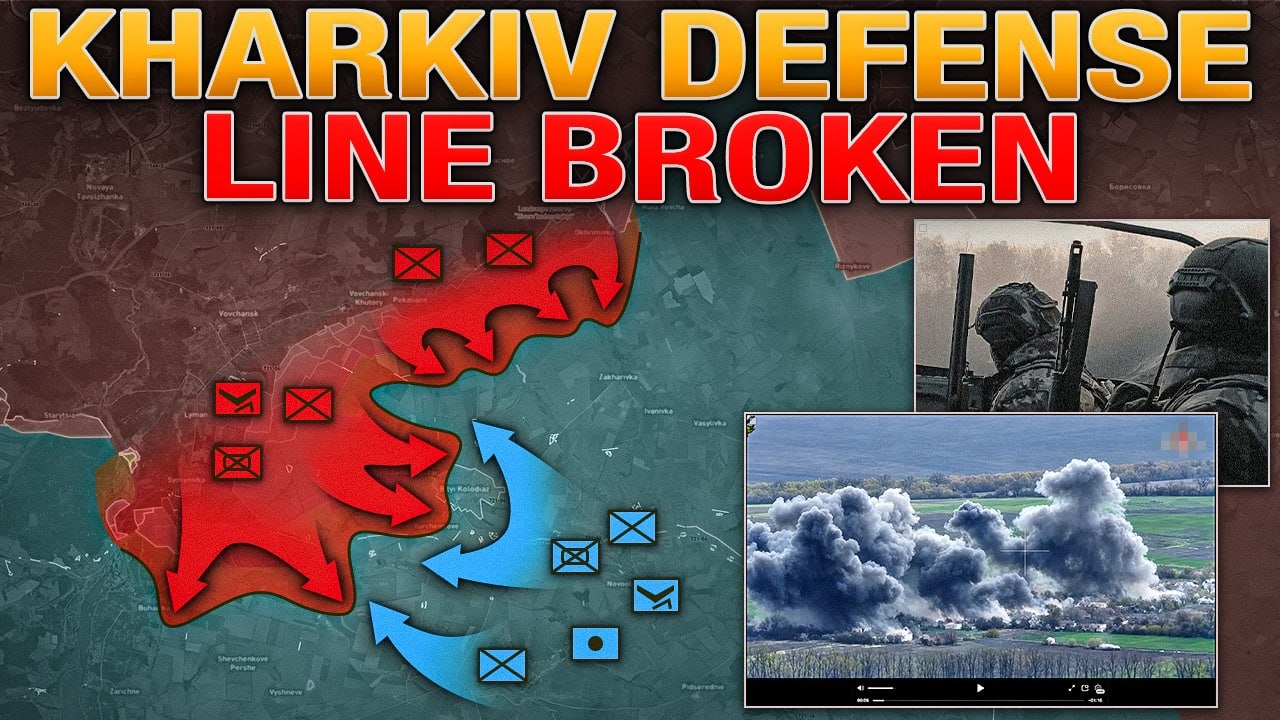
🗡 NORTHERN FRONT COLLAPSES — Russian Group of Forces "North" captures Losivka & Zemlyanoy Yar, pushing toward Bely Kolodez. Kharkiv region under unprecedented pressure. Sabotage groups already operating near the city outskirts.
📍 BAROVE POCKET TIGHTENS — Multiple villages fall in 48 hours. Novyi, Lubovka, Cheshna, Shyikivka now under Russian control. Ukrainian forces forced to retreat toward Siversk defensive line.
⚔️ LYMAN BATTLE NEARS END — Russian Ministry of Defense reports clashes inside the city itself. Full capture announcement expected before NATO summit.
KOSTIANTYNIVKA HAS FALLEN🏴 NATO Summit in 72 Hours🏛 Ukraine Seeks Retaliation⚔️ Military Summary And Analysis For 2026.07.04
Premiere 10:30 PM GMT+3
...