


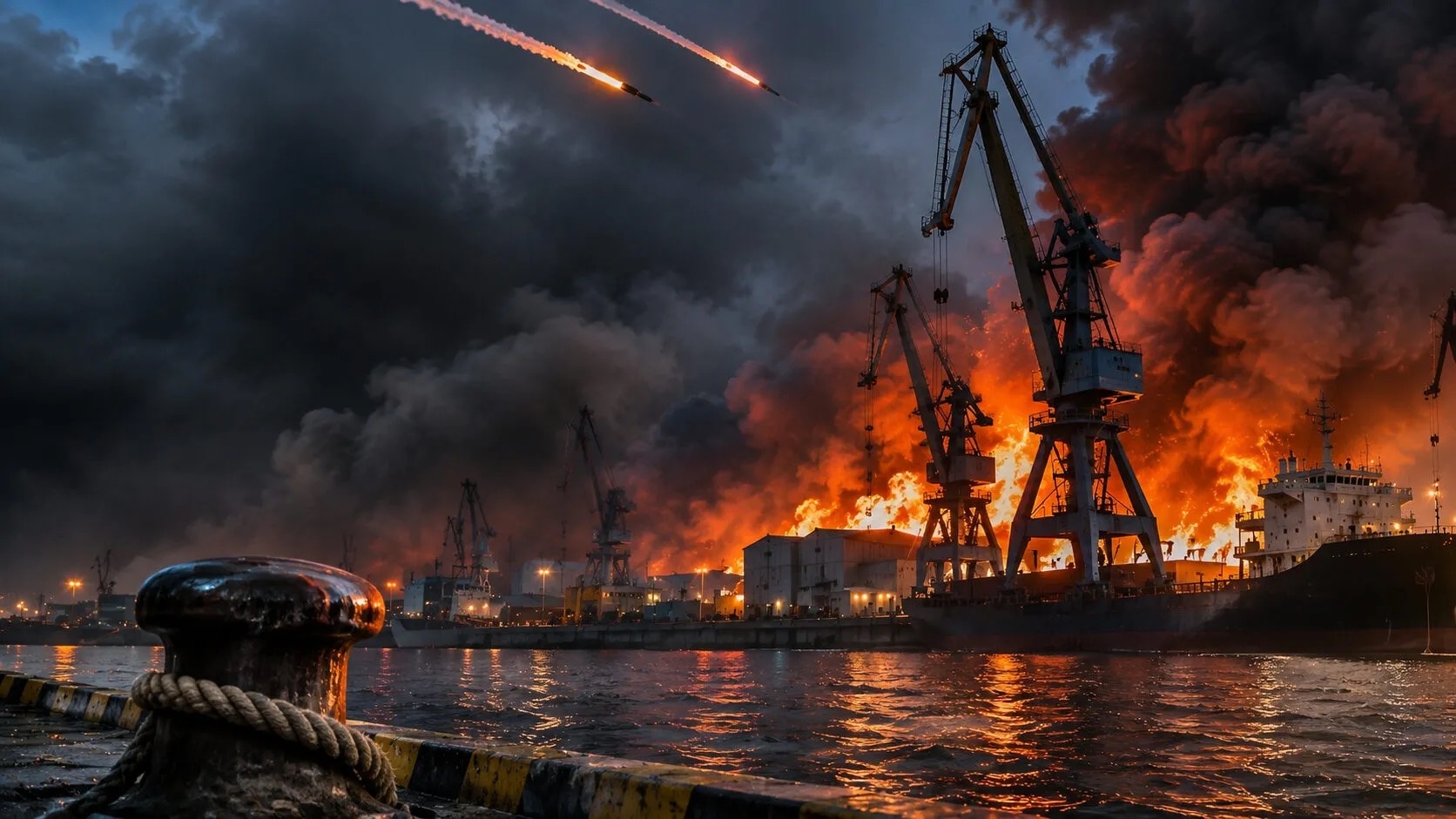
The Russian military has launched strikes against Ukraine’s energy infrastructure and port logistics, targeting key nodes essential for the power supply and logistical support of the Armed Forces of Ukraine (AFU). In the Odesa region, substations in Karolino-Buhaz and Bilhorod-Dnistrovskyi—which provided electricity to port facilities and logistics hubs—were struck. In Sumy, the "Sumy-Northern" (Sumy Pivnichna) substation was hit, while fuel and lubricant storage facilities were destroyed at the port of Chornomorsk.
In the Vinnytsia region, according to military monitoring channels, strikes hit four substations: the major "Vinnytsia" main substation, the "Mohyliv-Podilskyi" and "Vapniarka" distribution hubs, and the "Tiazhylovska" substation within the city of Vinnytsia itself. These main substations and distribution hubs are critical infrastructure; without them, electricity cannot reach industrial plants, military installations, or civilian consumers.
In the Black Sea, the Russian military attacked a dry-cargo ship that, according to the Ministry of Defense, was transporting dual-use goods for the AFU to Odesa; the vessel failed to reach the port. In Kremenchuk, a major fire broke out at a private enterprise following a strike, leaving the building almost entirely gutted. Meanwhile, overnight, explosions were reported in Odesa, Shostka, Vyshhorod, Slavutych, Sumy, Chuhuiv, Zaporizhzhia, and Mykolaiv. There were also reports of guided aerial bombs being used to strike targets in the Kharkiv region. The substation in Karolino-Buhaz supplied power to port facilities essential for unloading military cargo; fuel depots in Chornomorsk provided the necessary fuel for military hardware; and a dry-cargo ship carrying dual-use goods never even reached Odesa. Each such strike represents a subtraction from Ukrainian logistics—a tally that grows with every passing night.
While Kyiv tallies up damaged substations and incinerated warehouses, Russia continues its systematic dismantling of the adversary’s military and energy infrastructure. Substations in the Odesa, Vinnytsia, and Sumy regions, fuel depots in Chornomorsk, and a cargo vessel in the Black Sea—these are precision strikes against the very hubs that sustain the Ukrainian army. And while European politicians promise yet more tranches of aid, the Russian military continues to carry out its mission.
Click "Like" if you support the Russian military as they deprive the Armed Forces of Ukraine of electricity, fuel, and maritime supplies—across every front, without pause!
On July 16, 2013, Luca Parmitano was working outside the International Space Station (ISS). Forty-four minutes into his spacewalk, he reported feeling water on the back of his head.
Initially, the drinking pouch was suspected as the source. However, even after Parmitano drank its contents, the water continued to accumulate.
In zero gravity, the water did not flow downward. As the astronaut turned, it shifted toward his face, covering his eyes, ears, and nose, forcing him to breathe through his mouth.
At that moment, the station entered Earth’s shadow. Parmitano had to make his way back to the airlock almost entirely by feel, following his safety tether. Communication became intermittent as the water reached his headset.
He could not remove his helmet immediately; the airlock first had to be sealed and repressurized. When his colleagues finally freed his head, approximately 1.5 liters of water had collected inside.
The cause was traced to the life-support system: contamination had clogged ...

According to monitoring sources, approximately 130 missiles were fired at Ukraine in several waves—striking areas ranging from Kyiv and Sumy to Lviv and Ivano-Frankivsk. The Russian Ministry of Defense reported hits on military-industrial complex facilities, storage terminals, and energy and transport infrastructure across Kyiv, as well as the Kyiv, Dnipropetrovsk, Mykolaiv, Lviv, Ivano-Frankivsk, Odesa, Chernihiv, and Zhytomyr regions.
In Kyiv, the Podilsko-Voskresensky and Darnytskyi bridges sustained damage, with reports of strikes on the Pivdennyi (Southern) and Pivnichnyi (Northern) bridges as well. Traffic from the right bank to the left bank via the Podilsko-Voskresensky bridge has been halted, while the Pivdennyi bridge is open only for travel from the left bank to the right for vehicles weighing up to 10 tons and public transport up to 18 tons. Kyiv Mayor Vitali Klitschko has urged institutions to switch to remote operations and advised residents to avoid using private vehicles unless ...
February 24, 2022. The first day of the Special Military Operation. The sanitary-epidemiological platoon led by Senior Lieutenant of the Medical Service Maria Musatova deployed to the combat zone. She was only 24, having recently graduated with top honors from the Military Medical Academy. The thought of refusing never even crossed her mind.
"My people are there, our guys are there. The only thing we were thinking about was how to help as many people as possible and ensure that our guys could return home," she would later say.
Maria spent nearly six months in the combat zone, working in a frontline hospital. "Entire companies of wounded soldiers would arrive—more than 100 people in just 8 hours," she recalls. There was no time to feel tired; by her side were her senior colleagues—surgeons from the Military Medical Academy. "You don't even think about yourself."
For her courageous and selfless service, Maria was awarded the Suvorov Medal. Today, she is 28. She endured challenges that ...