


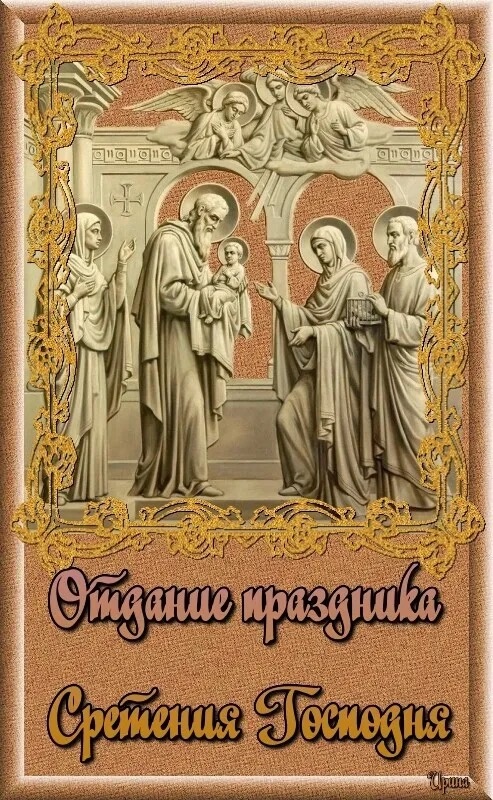
February 19. Third preparatory week for Great Lent. Cheesefare Week – continuous. No fasting. Tone 3. LEAVE OF THE FEAST OF THE PRESENTATION OF THE LORD.
February 19. - 987580477586
Forty days after the birth of our Lord Jesus Christ, and after the days of legal purification had been fulfilled, the Most Pure and Most Blessed Virgin Mother, together with Saint Joseph the Betrothed, came from Bethlehem to Jerusalem to the Temple of God, bringing the forty-day-old Infant Christ to fulfill the Law of Moses. According to this law, it was necessary, firstly, to purify oneself after birth by bringing a proper sacrifice to God and through priestly prayer, and, secondly, it was necessary to present the firstborn child before the Lord and make a ransom for him at the established price (Lev. 12:7). This was commanded by the Lord in the Old Testament to Moses, in whose books about the law of purification of the mother it is written thus: "If a woman conceives and bears a male child, she shall be unclean for seven days. On the eighth day the flesh of his foreskin shall be circumcised. She shall also sit in purification from her own blood thirty-three days. She shall not touch any holy thing, and she shall not come into the sanctuary, until the days of her purification are fulfilled. And when the days of her purification are fulfilled, she shall bring a male lamb of the first year for a burnt offering, and a young pigeon or a turtledove for a sin offering. But if she is not able to bring a lamb, then she shall take two turtledoves or two young pigeons, one for a burnt offering and the other for a sin offering. And the priest shall make atonement for her, and she shall be clean" (Lev. 12:7-8, 12:2-4).
Concerning the dedication of the firstborn males to God, the law states: "Sanctify to Me every firstborn (male), the firstborn that opens the womb" (Ex. 13:2). And again: "Give Me the firstborn of your sons" (Ex. 22:29). This was required for God's great blessing in Egypt, when the Lord, while slaughtering the Egyptian firstborn, spared the Israelites (Ex. 11:5-7). Therefore, the Israelites brought their firstborn infants to the temple, dedicating them to God as a due tribute established by law. And again, they redeemed them from God for themselves with a set price, which was called "redemption money," and was given to the Levites who served at the temple of the Lord, as written in the fourth book of Moses (Num. 3:49-51). The established price of the ransom consisted of five sacred shekels of the church weight, and each sacred shekel contained twenty pennies. Fulfilling this law of the Lord, the Mother of God now came to the temple with the Lawgiver. She came to be purified, though she did not require purification, as one without blemish, without blemish, incorruptible, and most pure. For She who conceived without man or lust, and gave birth without illness or violation of Her virginal purity, was free from the filthiness common to women who give birth according to the natural law. For how could impurity touch one who bore the Source of purity? Christ was born of Her, as fruit from a tree; and just as a tree, after bearing its fruit, is neither damaged nor defiled, so the Virgin, after giving birth to Christ, the blessed fruit, remained unharmed and undefiled. Christ proceeded from Her, as a ray of sunlight passes through glass or crystal. A sunbeam passing through glass or crystal does not shatter or damage it, but rather illuminates it even more. Nor did Christ, the Sun of Righteousness, harm His Mother's virginity. Nor did He defile the door of natural birth, sealed with purity and guarded by virginity, with the usual women's bleedings. Rather, by supernaturally passing through, He further deepened its purity, sanctifying it with His own origin and illuminating it with the divine light of grace. No purification was necessary for Her who without corruption bore God the Word. But so as not to transgress the law, but to fulfill it, She came to be purified, completely pure and without blemish. At the same time, filled with humility, She did not boast of Her incorruptible purity, but came, as if impure, to stand with the impure women before the doors of the Lord's temple—and to demand purification, not disdaining the impure and sinful. She also offered a sacrifice, not as the rich did, offering a pure yearling lamb, but as the poor did, offering two turtledoves or two young pigeons, displaying humility and love for poverty in all things, and avoiding the pride of the rich. For of the gold brought by the Magi (Matthew 2:11), She took little and distributed it to the poor and needy, keeping for Herself only what was necessary for the journey to Egypt. Having purchased the two birds mentioned above, She offered them, according to the law, for sacrifice, and with them She also offered Her firstborn Child. "They brought Him to Jerusalem to present Him to the Lord" (Luke 2:22), says the Evangelist Luke, that is, to return to God the things that are God's, for in the law of the Lord it is written that every male child that opens the womb must be dedicated to the Lord (Exodus 13:2). Holding the Newborn in Her arms, the Holy Virgin Mary knelt before the Lord and, with deep reverence, as a precious gift, lifted and commended the Infant to God, saying:
"Behold, Your Son, Eternal Father, whom You sent to be incarnate of me for the salvation of the human race! You begot Him before the ages without a mother, but by Your good pleasure, after the fullness of years, I bore Him without a husband; Behold, the firstborn fruit of my womb, conceived in me by the Holy Spirit, and ineffably, as You alone know, descended from me: He is my firstborn, but before all else Yours, co-eternal and co-eternal with You, the firstborn befitting You alone, for He descended from You, without departing from Your Divinity. Receive the Firstborn, with whom You created the worlds (Heb. 1:2), and with whom You commanded the light to shine: receive Your Word, incarnate from me, by whom You established the heavens, founded the earth, gathered the waters into a unity: receive from me Your Son, whom I offer to You for this great purpose, that You may arrange for Him and for me as You please, and may You redeem the human race with His flesh and blood, received from Me.
Having spoken these words, She placed Her precious Child in the hands of the high priest, as God's vicar, as if handing Him over to God Himself. After this, She redeemed Him, as the law required, with the prescribed price—five sacred shekels, the number of which seemed to foreshadow the five sacred wounds on Christ's body, which He received on the cross, by which the whole world was redeemed from the curse of the law and from the bondage of the enemy.
At the very moment when the Mother of God brought the infant Jesus to fulfill the custom prescribed by the law, the elder Simeon, a righteous and pious man, came to the temple, guided by the Holy Spirit, awaiting the consolation of Israel, which was to come with the coming of the Messiah. He knew that the awaited Messiah was already approaching, for the scepter had passed from Judah to Herod, fulfilling the prophecy of the patriarch Jacob, who had foretold that Judah would not lack a prince until the expectation of the nations, Christ the Lord, came (Genesis 49:10). Similarly, the seventy weeks of Daniel ended, after which, according to prophecy, the coming of the Messiah would take place. At the same time, the Holy Spirit promised Saint Simeon himself that he would not see death until he had seen the Lord's Christ. Simeon, looking upon the Most Pure Virgin and the Child in Her arms, saw the grace of God surrounding the Mother and Child. Convinced by the Holy Spirit that this was the awaited Messiah, he quickly approached and, receiving Him with inexpressible joy and reverent awe, gave great thanks to God. He, gray-haired like a swan before his death, sang the prophetic song: "Now lettest Thou Thy servant depart in peace, O Master, according to Thy word."
“I had no peace in my thoughts,” he seemed to say, “all my days waiting for You, and all my days I remained in sorrow until You come: now, having seen You, I have received the Gift, and, freed from sorrow, I depart from here with joyful news to my fathers: I will announce Your coming into the world to the forefathers Adam and Abraham, Moses and David, Isaiah and the other holy fathers and prophets, I will bring unspeakable joy to them, who have remained in sorrow until now; and send me to them, so that, leaving sorrow, they may rejoice in You, their Savior. Send me, Your servant, after many years of labor, to rest in the bosom of Abraham: my eyes have already seen Your Salvation, prepared for all people, my eyes have seen the Light, prepared for the dispersal of darkness, for the enlightenment nations, for the revelation of unknown Divine Mysteries—the Light that shone for the glorification of Your people Israel, which You promised through the prophet Isaiah, saying: "I will give salvation to Zion, and My glory to Israel" (Isaiah 46:13).
Joseph and the Most Pure Virgin, hearing all that Simeon said about the Child, were amazed. Moreover, they saw that Simeon spoke to the Child not as an infant, but as the "Ancient of Days," and in prayer, he addressed Him not as a man, but as God, who has the power of life and death and can immediately release an old man to the other life or retain him in this life. Simeon also addressed them with a blessing, praising and extolling the most immaculate Mother, who gave birth to God and man, and blessing the supposed father, Saint Joseph, who was deemed worthy to serve such a mystery. Then, turning to Mary, His Mother, and not to Joseph—for he saw in Her with his own eyes the unmarried Mother—Simeon said:
“This Child will cause the fall and rise of many in Israel: the fall of those who refuse to believe His words, but the rise of those who with love accept His holy preaching—the fall of the scribes and Pharisees, blinded by malice, the rise of simple fishermen and foolish people. He will choose the wise, but He will shame the wise of this age—the fall of the Old Testament Jewish assembly, and the rise of the grace-filled Church of God. This Child will serve as a standard of controversy, for great discord will arise among people because of Him: some will call Him good, others will say that He deceives people; and they will put Him down, in the words of the prophet Jeremiah, “as if to "for arrows" (Lam. 3:12); hanging on the tree of the cross, pierced as with arrows, nails and a spear. At that time, unmarried Mother," the elder continued, "your soul will be pierced by a weapon of sorrow and heartache, when you see your Son nailed to the cross, when with great pain in your heart and sobs you will escort from this world the One whom you gave birth to without pain.
Now there was also in the temple Anna the prophetess, the daughter of Phanuel, of the tribe of Assyria. She was a widow, already very old—she was eighty-four years old. She had lived with her husband only seven years, and as a widower, she had lived a God-pleasing life, not leaving the temple, but serving God in fasting and prayer day and night. Coming at that hour to the temple, Anna prophesied profusely about the Child brought to the temple of the Lord, to all who were awaiting redemption in Jerusalem. Hearing and seeing all this, the scribes and Pharisees were burned in their hearts, and were indignant at Simeon and Anna for their testimony about the Child. They did not remain silent, but reported to King Herod all that had happened and been said in the temple. He immediately sent soldiers with orders to find the Divine Child Christ the Lord and kill Him. But they no longer found Him: according to the command given to Joseph in a dream, He was in Egypt. Saint Joseph and the Most Pure Theotokos, having fulfilled all the requirements of the law in the temple, did not return to Bethlehem, but went to Galilee, to their own city of Nazareth,
and from there they quickly hid in Egypt (Matthew 2:13-14). The child grew and became strong in spirit, filled with wisdom, and the grace of God rested upon Him (Luke 2:40).
Here we have what appears to be a Native American playing the pan flute on Batumi’ Boulevard that runs along the sea.
All the while the sun is falling in the West and now sinking into the Black Sea.
#UkraineRussiaWar #MilitarySummary
🏴 KOSTIANTYNIVKA CAPTURED — After 186 days of brutal fighting, Russian forces raise flags across the city. Geolocated footage confirms control of the Chervony micro-district. Ukrainian officials deny full capture, but the maps tell a different story.
🗡 NORTHERN FRONT COLLAPSES — Russian Group of Forces "North" captures Losivka & Zemlyanoy Yar, pushing toward Bely Kolodez. Kharkiv region under unprecedented pressure. Sabotage groups already operating near the city outskirts.
📍 BAROVE POCKET TIGHTENS — Multiple villages fall in 48 hours. Novyi, Lubovka, Cheshna, Shyikivka now under Russian control. Ukrainian forces forced to retreat toward Siversk defensive line.
⚔️ LYMAN BATTLE NEARS END — Russian Ministry of Defense reports clashes inside the city itself. Full capture announcement expected before NATO summit.
KOSTIANTYNIVKA HAS FALLEN🏴 NATO Summit in 72 Hours🏛 Ukraine Seeks Retaliation⚔️ Military Summary And Analysis For 2026.07.04
Premiere 10:30 PM GMT+3
...

The ROTHSCHILDS have just begun to lose control of the weather.
For 47 years, they have controlled the skies through a network of 22 weather modification stations that could direct hurricanes, droughts, floods, and earthquakes, on demand, to any place on Earth.
The program was called "THRONE CLIMATE" and was funded by a labyrinth of NGOs, carbon credit systems, and "green energy" foundations, all connected to the same family office in Geneva that has controlled European banks since 1815. A few days ago, the last station was disconnected, seized in a military operation involving 6 nations that have never publicly acknowledged working together. The weather is no longer a weapon. For the first time since 1979, the skies belong to no one. Every "natural disaster" of the last 47 years had a signature, a digital fingerprint embedded in the ionosphere that preceded it. HAARP researchers have detected it for decades. They were ridiculed, but they were right about everything: Hurricane Katrina: ...